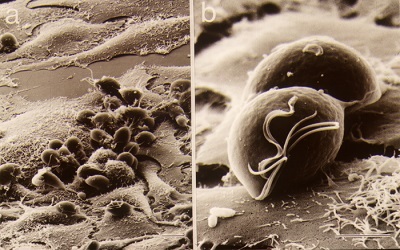
Scanning electron microscopy image of numerous Trichomonas vaginalis organisms attached to epithelial cells grown in the laboratory (left). An enlargement of the microscopy photo showing two organisms grown in the laboratory (right). Credit: Washington State University
Key points:
- A new point-of-care test can detect a prevalent, but rarely discussed STI in under 5 minutes for only $20.
- Trich can cause long-term health complications if undiagnosed.
- Estimates indicated there are more than 9.2 million trish cases annually.
Trichomonas vaginalis, also known as trich, affects more people than chlamydia or gonorrhea, yet causes no symptoms in about 70% of those infected. While the STI is easily treated with a drug, if left untreated, it can lead to a number of health complications, including increased susceptibility to HIV, prostate cancer in men and pregnancy complications and infertility in women.
To prevent untreated complications, Washington State University researcher John Alderete has been working for years to improve testing capabilities. His latest development, detailed in Pathogens, is a finger-prick test that delivers results in 5 minutes and can be produced for under $20.
“We know a lot about the biology of this organism,” said Alderete, the study lead author and professor in WSU’s School of Molecular Biosciences. “There probably will never be a vaccine for trich simply because the organism is well equipped to evade our immune responses. But I’d argue we don't need a vaccine. We just need to diagnose people, and once diagnosed, they can be cured.”
The new test requires only a drop of blood to detect an antibody specific to trich. Alderete previously identified this biomarker, an alpha-actinin protein unique to this organism named ACT::SOE3 in earlier research. Both men and women make the antibody when they are infected.
Working with the company MedMira, Alderete used their diagnostic platform for his finger-prick test. Similar to COVID-19 and pregnancy tests, the results are displayed in a window with a dot appearing if the antibody is present, indicating infection.
Alderete estimates there are more than 9.2 million trish cases annually based on incidence rates and census data. One study found that 50% of pregnant women had persistent undiagnosed infections—a significant concern since trich is associated with pre-term membrane rupture, preterm birth and low infant birth weight.
“Trich is the most common STI you've probably never heard of,” he said.
Patent protection on Alderete’s new development is in process.